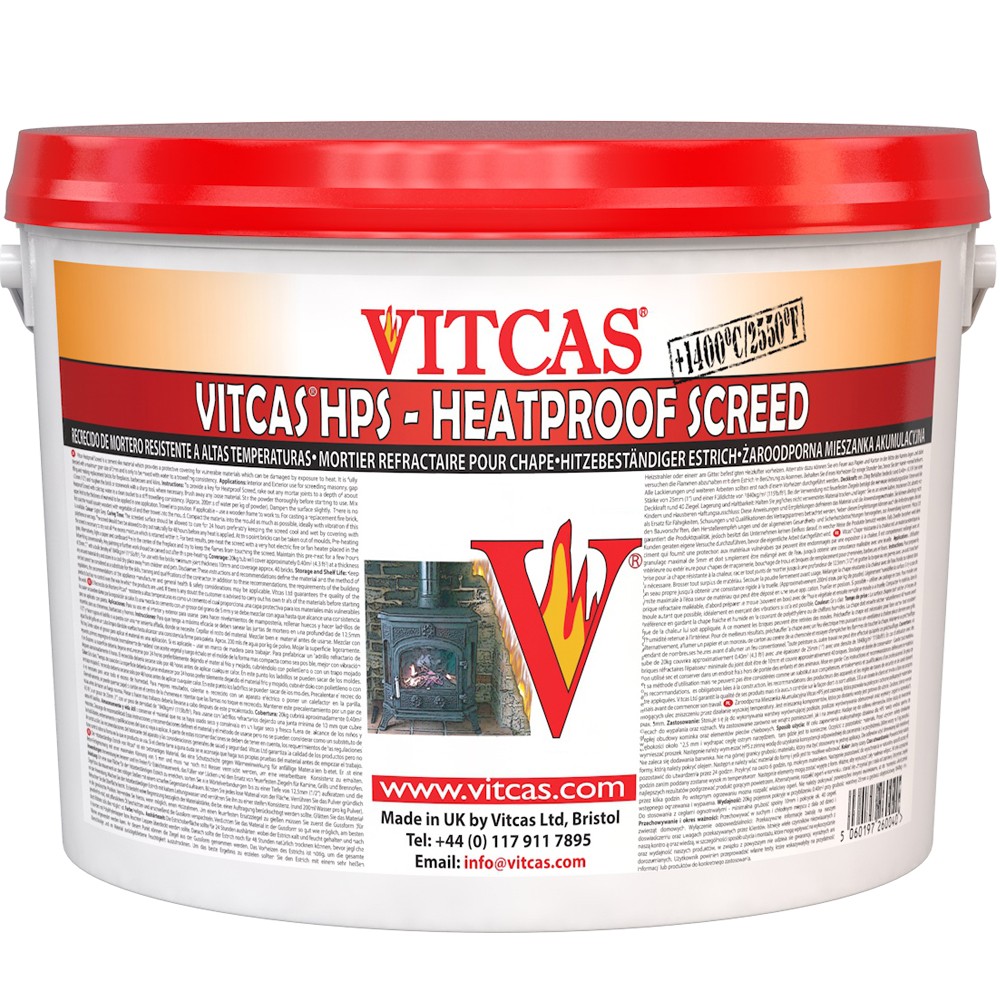
Heatproof Screed is selected for specific refractory layers and fillings, not for every garden oven base. Before ordering, determine whether you need a load-bearing foundation, working layer, or thermal insulation. Recording these functions separately prevents the use of one material in several unintended roles.
Define the material’s working location
Vitcas Heatproof Screed is a cementitious refractory material with a declared resistance of up to 1400°C, intended for appropriate indoor and outdoor applications. The manufacturer describes, among other things, the creation of refractory layers and larger fillings. Each of these applications requires a compatible substrate and geometry.
Do not assess the load-bearing capacity of the foundation based solely on the temperature class. The support of the entire oven must result from the construction design. Similarly, a thick, compact refractory layer does not replace low-conductivity insulation just because it withstands heating well.
Plan the interfaces with adjacent layers
In appropriate arrangements, the insulation under the chamber is created by ceramic fibre board. Its thickness, support, and edge protection are determined for the specific oven. Check where each layer ends and how it will be protected from water.
Before applying the screed, assess the stability of the substrate and its preparation. A new wall must meet the requirements before applying the next layer. On old surfaces, remove weak material and prepare the contact according to the product instructions; a smooth or dirty substrate does not provide a predictable bond.
Take curing and drying into account
Measure the water and mix the batch according to current recommendations. Do not add random pigments or other binders. The method of consolidation and finishing should correspond to the layer being applied.
After application, plan the required setting, curing, and further drying. Do not accelerate work with intense heat. Before covering, take photos of the section and terminations; in later repair work, they will help determine the locations of the refractory layer, insulation, and structural support.